- Period
- 2021–2025
- Location
- Santa Maria, Santa Cruz do Sul and Lajeado, Rio Grande do Sul, Brazil
- Partners
- Regional development research group led by Rogério Leandro Lima da Silveira
- My role
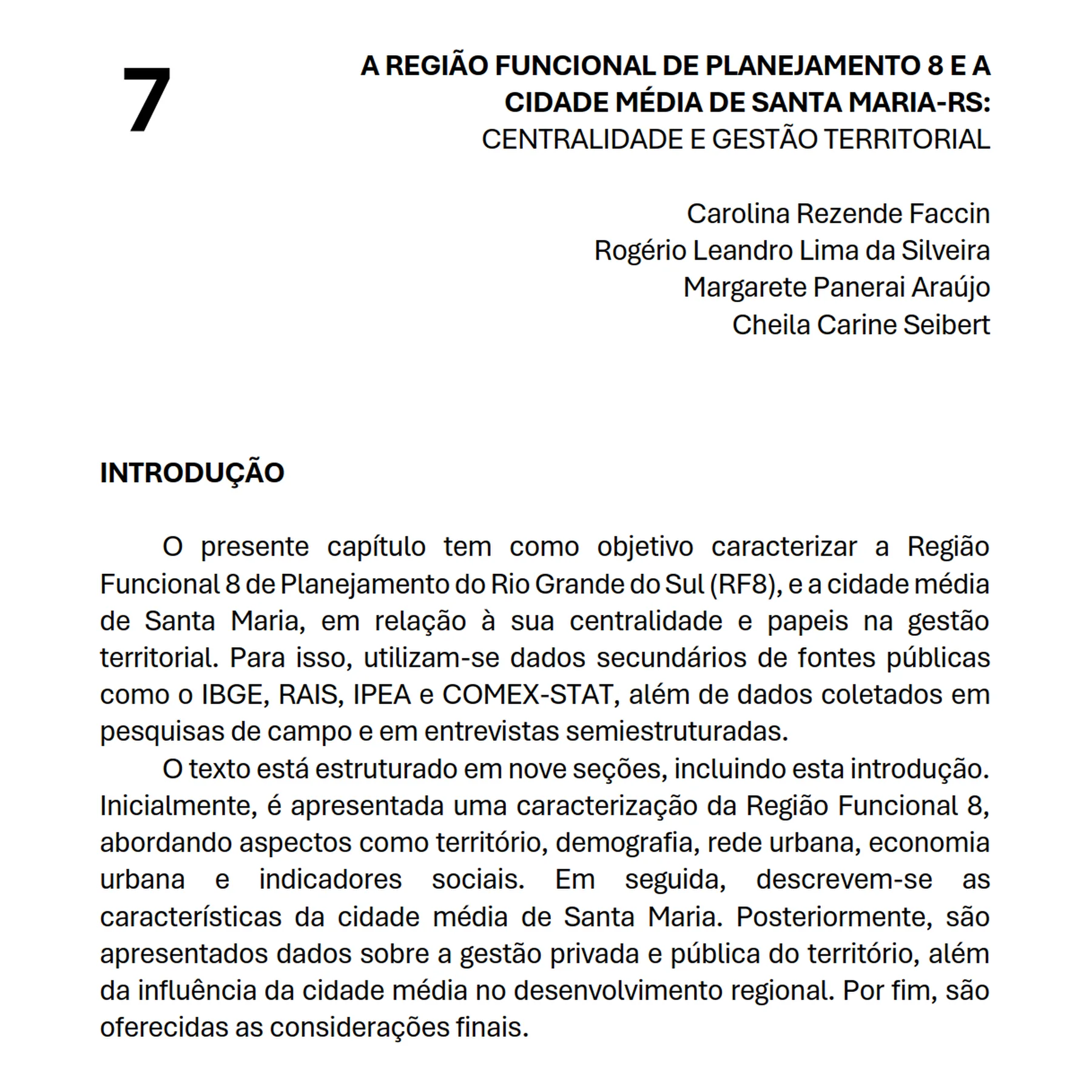
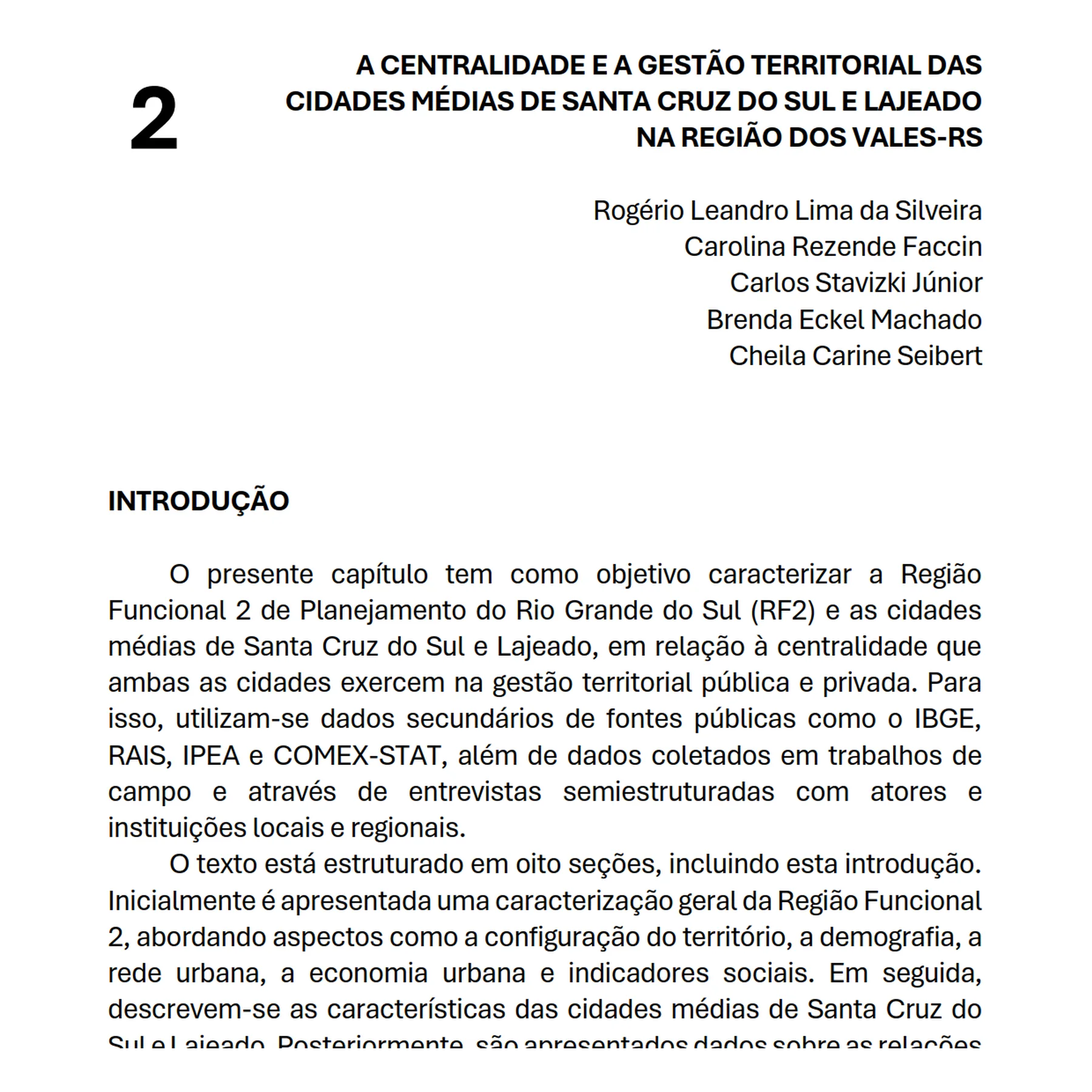
- Lead author of the Santa Maria chapter and co-author of the Santa Cruz do Sul and Lajeado chapter: secondary data analysis, fieldwork, interviews and maps.
- Data
- IBGE (Regions of Influence of Cities, Territorial Management) · RAIS · IPEA · COMEX STAT · Fieldwork · Semi-structured interviews
- Tools & methods
- QGIS · Excel · Interviews · Network and flow analysis
The challenge#
Outside metropolitan areas, a few medium-sized cities host the regional offices of state agencies, universities, hospitals and company branches. These management functions decide where services are delivered and where investment flows, but they are rarely measured explicitly in regional planning.
Approach#
Each case study characterized a state planning region and its medium-sized city, combining secondary data with fieldwork and semi-structured interviews with local and regional actors and institutions.
- Regional profile
Territory, demography, urban network, economy and social indicators
- Management flows
Links between headquarters and branches of public agencies and companies
- Fieldwork
Interviews with local and regional institutions
- Centrality
The city’s role in regional development
Results#
- A detailed characterization of Santa Maria in Planning Region 8, and of Santa Cruz do Sul and Lajeado in Planning Region 2, including their centrality and role in public and private territorial management.
- In related work on the north-central part of the state (Passo Fundo and Erechim), public management showed a polynuclear pattern with one-way flows, while private management was monocentric with multidirectional flows.
- Evidence that medium-sized cities anchor regional development, in a context of expanding market logic and growing sociospatial inequality.
Why it matters#
Understanding which cities concentrate management functions helps target investment in services and infrastructure, and design regional policies that strengthen, rather than drain, the surrounding small municipalities.
- E-book Cidades médias, gestão territorial e desenvolvimento regional (PT), including:
- Faccin, Silveira, Araújo & Seibert (2025): Planning Region 8 and the medium-sized city of Santa Maria.
- Silveira, Faccin, Stavizki Júnior, Machado & Seibert (2025): Santa Cruz do Sul and Lajeado in the Vales Region.
- Silveira et al. (2022) (PT): medium-sized cities and territorial management in north-central Rio Grande do Sul.